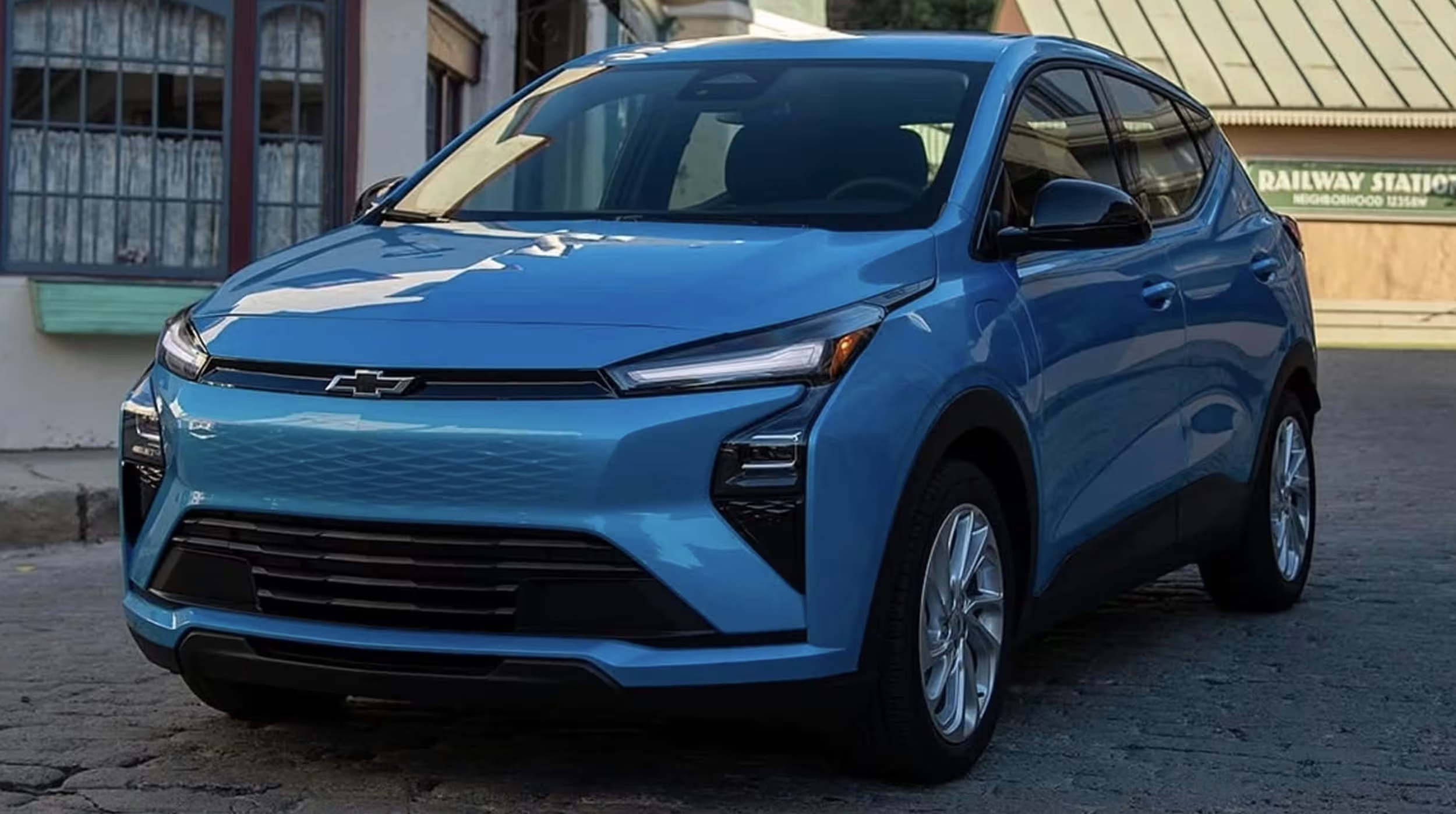

After skipping the 2024, 2025, and 2026 model years, Chevrolet has officially revived its beloved compact EV with a starting price of just $28,995 (including destination), making the 2027 Bolt the most affordable electric vehicle on sale in the United States today.
That price undercuts every other EV currently available — including the Nissan Leaf, Hyundai Kona Electric, and Fiat 500e. But Chevy didn’t just slash costs. The 2027 Bolt brings a completely new battery chemistry, dramatically faster charging, a native Tesla-compatible charging port, and a redesigned interior with Google Built-In infotainment. Here’s everything you need to know.
Price and Trims: Two Ways to Bolt
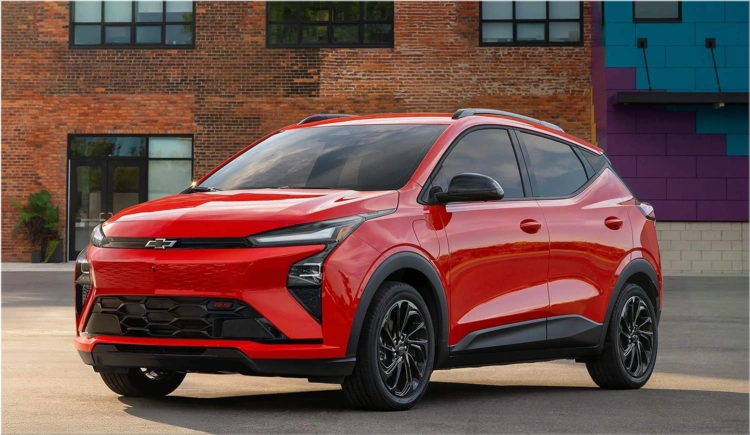
The 2027 Bolt comes in two trims. The Bolt LT starts at $28,995 and serves as the value play — cloth seats, an 11-inch digital instrument cluster, 11.3-inch touchscreen with Google Built-In, and a full suite of standard safety features. The Bolt RS starts at $32,995 and adds sportier exterior styling with a unique front grille, gloss black roof rails, RS badging, and a more aggressive interior with black Evotex seating and red stitching plus multicolor ambient lighting.
Both trims share identical powertrains and range. Super Cruise — GM’s hands-free highway driving system — is available on both, though it requires stacking several option packages. A fully loaded Bolt RS with Super Cruise, the Technology Package, and a panoramic sunroof tops out around $38,990.
The LFP Battery: A Game-Changer Under the Floor
The biggest engineering story here is what’s underneath. The 2027 Bolt is GM’s first North American EV to use Lithium Iron Phosphate (LFP) battery cells, replacing the nickel-manganese-cobalt chemistry used in the previous generation. The capacity stays at 65 kWh, but the benefits of LFP are significant.
LFP batteries are cheaper to produce because they eliminate expensive critical minerals like cobalt and nickel. They’re also more thermally stable, degrade less over time, and — crucially — can be charged to 100% regularly without damaging the cells. Previous Bolt owners were advised to limit daily charging to 80%. That restriction is gone.
Despite the same battery capacity, the 2027 Bolt actually delivers more range: 262 miles on a single charge, up from 247 miles on the outgoing Bolt EUV. The gain comes from a more efficient electric motor and power electronics borrowed from the Chevrolet Equinox EV.

150 kW Fast Charging and Native NACS Port
This is where the 2027 Bolt makes its most dramatic leap. The previous Bolt was famously limited to just 55 kW DC fast charging — painfully slow for road trips and a dealbreaker for many buyers. The 2027 model nearly triples that to 150 kW, enabling a 10% to 80% charge in approximately 26 minutes. That actually makes it faster to charge than the larger Equinox EV, Blazer EV, and even the Cadillac Lyriq.
Equally important: the 2027 Bolt is the first Chevrolet to ship with a native NACS (North American Charging Standard) port — the same connector used by Tesla’s Supercharger network. No adapter needed. Just pull up and plug in. With access to Tesla’s vast Supercharger infrastructure on top of GM’s Ultium Charge 360 network (over 250,000 public chargers), charging anxiety becomes far less of a concern. Plug-and-charge capability on the Tesla network is expected later in 2026.
Under the Hood: Familiar but Refined
The 2027 Bolt produces 210 horsepower (up from 200 hp) and 169 lb-ft of torque from a single front-mounted electric motor shared with the Equinox EV. Front-wheel drive is standard — there’s no AWD option. One-pedal driving mode returns and can be toggled through the infotainment system, persisting through restarts.
On the road, the Bolt remains what it’s always been: punchy off the line, composed in corners, and quiet at highway speed. It’s a subcompact that drives bigger than it looks, with a ride quality that reviewers say has improved over the outgoing model.
Interior: All New Where It Counts
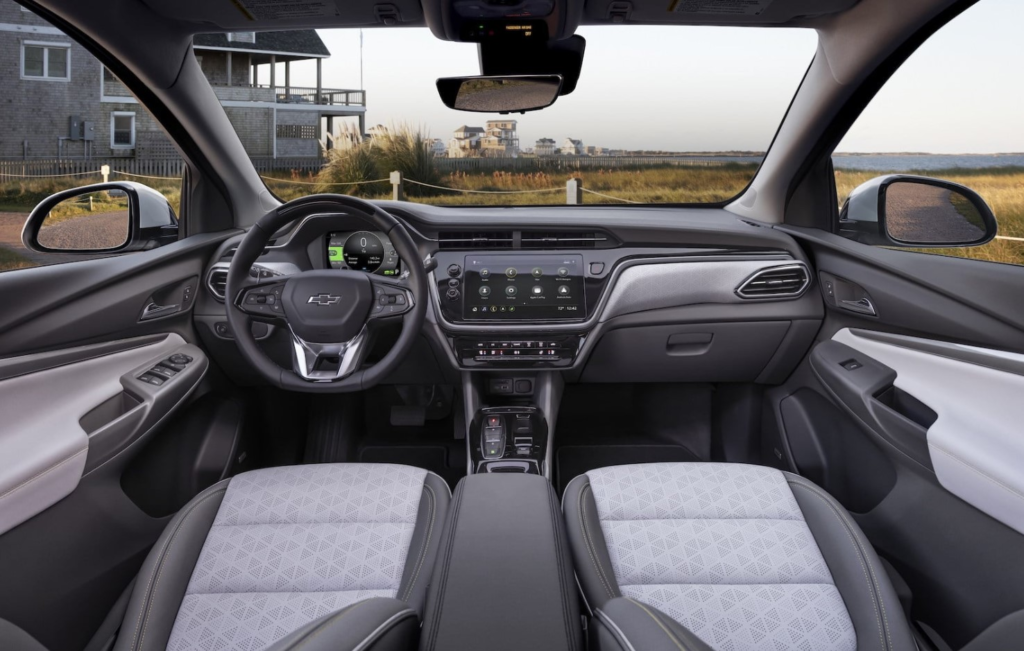
Step inside and the changes are immediately obvious. The dashboard is completely redesigned around a dual-screen setup: an 11-inch digital driver display (carried over from the Equinox EV) and an 11.3-inch central touchscreen (adapted from the Chevy Colorado to keep costs down). Both are larger than the previous model’s screens.
The infotainment system runs Google Built-In, which means native Google Maps with EV-specific routing and charger awareness, Google Assistant voice control, and access to the Google Play Store. The trade-off? Apple CarPlay and Android Auto are gone — GM has removed phone projection from all its new vehicles. Spotify and Apple Music apps are available natively, though early reviews note they aren’t quite as responsive as their CarPlay counterparts.
A new column-mounted shifter frees up console space, and the open center console design provides more accessible storage. Cargo space comes in at 16.3 cubic feet behind the rear seats, expanding to 56.3 cubic feet with the seats folded — competitive for the subcompact class.
Safety and Driver Assistance
The 2027 Bolt comes standard with over 20 safety and driver-assistance features, including automatic emergency braking, lane keep assist, lane departure warning, rear cross-traffic braking, and a rear camera mirror. The available Super Cruise system enables true hands-free driving on over 750,000 miles of compatible North American highways, with automatic lane changing capability.
The Bolt also supports Vehicle-to-Home (V2H) bidirectional charging when paired with a GM Energy Home System, allowing the car to serve as a backup power source during outages — a feature that’s becoming increasingly valuable.
The Catch: It Won’t Be Around Forever
Here’s the bittersweet reality. Chevrolet has been upfront that the 2027 Bolt will have a “limited run.” The car is being built at GM’s Fairfax Assembly Plant in Kansas, which is scheduled to switch over to producing gasoline-powered Equinox SUVs and the next-generation Buick Envision by mid-2027. Chevy hasn’t committed to continuing Bolt production beyond that window.
The loss of the $7,500 federal EV tax credit and the current tariff environment have made the economics more challenging for affordable EVs. If you’ve been waiting for the right moment to go electric at a price that makes sense — this might be it.
The Bottom Line
The 2027 Chevy Bolt is everything an affordable EV should be in 2026. At $28,995, you get 262 miles of range, 150 kW fast charging, a native NACS port for Tesla Supercharger access, a modern Google-powered infotainment system, and over 20 standard safety features. The LFP battery means you can charge to 100% without worry, and the shared GM components keep the price honest without cutting corners.
It’s the most compelling value in the EV market today. The only question is how long it’ll be around.
2027 Chevy Bolt — Quick Specs
| Starting Price | $28,995 (LT) / $32,995 (RS) |
| Range | 262 miles (EPA est.) |
| Battery | 65 kWh Lithium Iron Phosphate (LFP) |
| DC Fast Charging | 150 kW (10-80% in ~26 min) |
| Charging Port | Native NACS (Tesla Supercharger compatible) |
| Motor | Single front-mounted, 210 hp / 169 lb-ft |
| Drivetrain | Front-wheel drive |
| Infotainment | 11.3″ touchscreen, Google Built-In |
| Driver Display | 11″ digital instrument cluster |
| Cargo Space | 16.3 cu ft / 56.3 cu ft (seats folded) |
| Available Super Cruise | Yes (hands-free highway driving) |
| V2H Capable | Yes (with GM Energy Home System) |
| Assembly | GM Fairfax Plant, Kansas (limited run) |