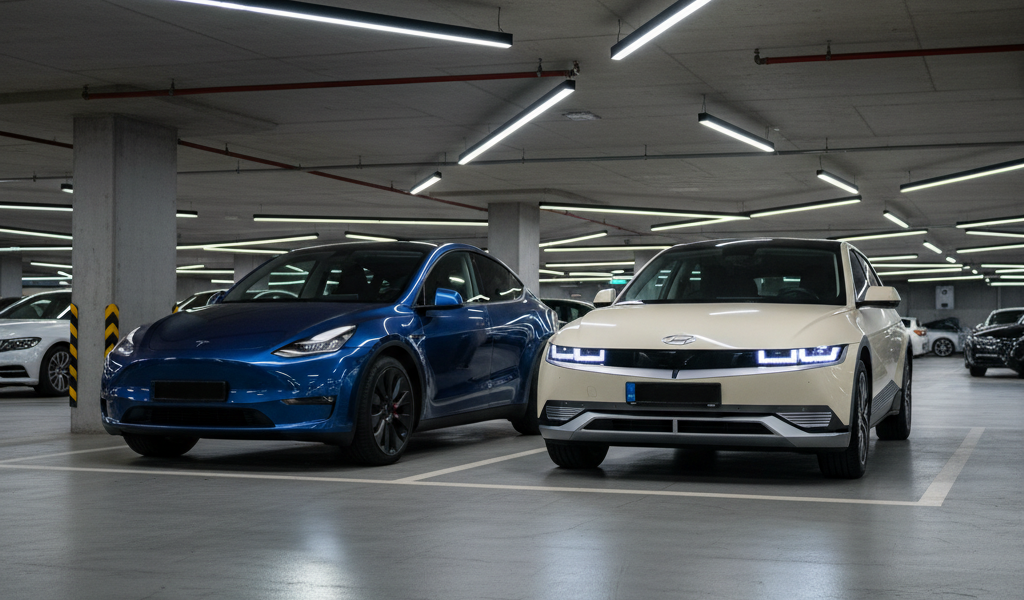
2026 EV Showdown: Tesla Model Y vs. Hyundai Ioniq 5 – The Atlanta Driver’s Real-World Verdict
Alright, folks, let’s talk about the future, because it’s coming faster than a Model S Plaid off the line. We’re looking ahead to 2026, and if you’re like me – an Atlanta parent juggling I-85 commutes, weekend soccer tournaments, and those dreaded Costco runs – you’re probably wondering which EV truly earns its spot in your garage. Today, we’re putting two titans head-to-head: the refreshed Tesla Model Y and the updated Hyundai Ioniq 5. Both are phenomenal machines, but for your hard-earned money, which one makes more sense?
I remember back when I got my first EV, the options felt limited. Now, by 2026, the market is buzzing with contenders. But for families needing space, range, and practicality without sacrificing an ounce of cool factor, the Model Y and Ioniq 5 consistently rise to the top. Let’s dig in.
Price: Where Your Wallet Feels the Pinch (or the Relief)
By 2026, I expect both these vehicles to have settled into a competitive sweet spot, but inflation and demand are real. For the Tesla Model Y, assuming the ‘Juniper’ refresh has landed, I’m projecting a starting price around $46,000 for the Rear-Wheel Drive (RWD) Standard Range. The Long Range All-Wheel Drive (AWD) will likely hover around $53,000, and the Performance model probably closer to $60,000. Remember, Tesla’s direct sales model means no dealer markups, which is a huge win in my book. What you see is what you pay (plus taxes and fees, of course).
The Hyundai Ioniq 5, fresh off its 2025 battery update and minor tweaks, should start around $44,000 for its RWD variant with the larger 84 kWh battery. The AWD version will likely be in the $49,000 range. Here’s the kicker: if Hyundai manages to get enough of its battery components sourced domestically, the Ioniq 5 could still qualify for some federal tax credits, making it an incredibly compelling value proposition. However, dealing with dealerships can be a headache, and while the early markup madness has subsided, you still need to be vigilant.
Initial thought: The Ioniq 5 might offer a slightly better entry point and potentially qualify for more incentives. Tesla’s transparency on pricing is a huge comfort, though.
Range: Going the Distance on Georgia’s Roads
Range anxiety? That’s so 2020. By 2026, both these EVs are more than capable of handling my regular pilgrimage from Alpharetta down to Hartsfield-Jackson and back, or a weekend jaunt up to the North Georgia mountains.
The refreshed Model Y RWD should comfortably hit an EPA-estimated 270 miles, with the Long Range AWD pushing 320 miles. The Performance model will be around 290 miles. Tesla is constantly optimizing, and their real-world range often matches or even slightly exceeds EPA figures if you’re not driving like you’re on a racetrack. On a hot Atlanta summer day with the AC blasting, you’ll see a dip, but nothing that’ll leave you stranded.
The updated Ioniq 5, with its new 84 kWh battery, is projected to be a serious contender. I’m expecting the RWD model to achieve around 330 miles of EPA range, potentially making it a segment leader. The AWD variant should hit a very respectable 300 miles. Hyundai has been excellent at squeezing efficiency out of its E-GMP platform, and these numbers mean fewer stops on those long road trips.
My take: The Ioniq 5, particularly the RWD, might just edge out the Model Y in pure EPA range by 2026, thanks to that bigger battery. But both are more than enough for 99% of drivers.
Charging: Speed, Convenience, and the NACS Effect
This section is where the game has changed dramatically. The Tesla Model Y, by 2026, will still leverage its undisputed champion of charging networks: the Supercharger. It’s reliable, ubiquitous, and just works. Plug in, and you’re charging. The Model Y, built on a 400V architecture, can still pull impressive speeds, typically maxing out around 250 kW, allowing for a 10-80% charge in about 25-30 minutes.
Now, for the Hyundai Ioniq 5, this is where it gets exciting. With Hyundai’s adoption of the North American Charging Standard (NACS) by 2025, the Ioniq 5 will gain access to that same Supercharger network. Coupled with its native 800V architecture, the Ioniq 5 can theoretically charge from 10-80% in an astonishing 18 minutes at a 350 kW charger (which Superchargers aren’t, but Electrify America and EVgo often are). That 800V tech is a game-changer for reducing road trip stops, especially when you can find a capable charger. The Model Y charges fast, but the Ioniq 5’s 800V system has an undeniable advantage on capable DC fast chargers.
Verdict on charging: The Ioniq 5, with NACS and its 800V architecture, offers the best of both worlds: access to the best network AND the fastest charging speeds on high-power stations. This is a huge win for Hyundai.
Interior: Minimalist Tech vs. Retro-Futuristic Comfort
Stepping inside, you’ll immediately notice the philosophical differences. The Model Y’s interior, even after the ‘Juniper’ refresh, will likely retain its signature minimalist design. A giant central screen controls almost everything. It’s clean, futuristic, and some love it. Others, like me when I’m trying to adjust the AC while stuck in I-285 traffic, sometimes wish for a physical button. The materials might get a slight bump in quality, but the overall aesthetic will remain. It’s spacious, especially with the panoramic glass roof, and those two extra seats in the 7-seater option (though tight) can be a lifesaver for youth sports carpooling.
The Ioniq 5’s interior, on the other hand, is a masterclass in retro-futuristic design and comfort. It feels more like a lounge on wheels, with its flat floor, sliding center console, and dual 12.3-inch screens seamlessly integrated. The materials are top-notch, and the physical buttons for climate and audio are a welcome touch of practicality. For 2026, I’m expecting the confirmed rear wiper and perhaps some minor software refinements, but the core ‘living space’ feel will endure. For families, the sheer comfort and thoughtful storage solutions often win hearts.
My preference: While I appreciate Tesla’s tech, the Ioniq 5’s interior just feels more inviting and user-friendly for everyday family life. Especially when you’re loading up sports gear and need quick access to controls.
Driving Experience: Performance Prowess vs. Cushioned Cruise
How do these two feel on the road? The Tesla Model Y is, unmistakably, a Tesla. It offers brisk acceleration even in its base RWD form, and the Performance model is genuinely quick enough to plaster a smile on your face every time you merge onto the highway. The handling is sharp, direct, and sporty, though the ride can sometimes feel a bit firm over Atlanta’s less-than-perfect pavement. It’s an engaging drive, prioritizing performance and agility.
The Hyundai Ioniq 5 takes a slightly different approach. While the AWD version is no slouch (0-60 in about 4.5 seconds!), it prioritizes comfort and a smooth, composed ride. It floats over bumps rather than crashing through them, making it an absolute joy on longer trips. The steering is light and precise, and it feels incredibly stable at highway speeds. It’s not as aggressively sporty as the Model Y, but it’s refined and incredibly pleasant. I’ve heard too many stories about higher insurance costs for Teslas due to repair complexities; something to factor in for both of these, but especially the Model Y.
Driving verdict: If you crave performance and a sporty feel, the Model Y still holds a slight edge. But for overall comfort, refinement, and a truly relaxing commute, the Ioniq 5 is tough to beat.
Verdict: Which One Should You Buy in 2026?
This is where the rubber meets the road, literally. Both the 2026 Tesla Model Y and Hyundai Ioniq 5 are fantastic EVs that represent the best of what the market has to offer. They’re both spacious enough for a family, have excellent range, and advanced tech.
However, if I had to recommend one for the average Atlanta family looking for the absolute best blend of value, cutting-edge charging, and a truly comfortable, practical experience, my money is on the Hyundai Ioniq 5 (2026).
Why? The NACS adoption by Hyundai is a game-changer, giving it access to the Supercharger network while retaining its blisteringly fast 800V charging architecture. The potential for federal tax credits, coupled with its slightly lower starting price, makes it incredibly appealing. The interior is simply more inviting and user-friendly, and the comfortable ride is a huge bonus for daily driving and those inevitable road trips. The Model Y is a phenomenal machine, but the Ioniq 5 brings a level of thoughtful design and charging supremacy that, by 2026, will be hard to ignore.
Bottom Line:
For 2026, the Hyundai Ioniq 5, with its blend of value, potentially class-leading range, superior charging flexibility (thanks to NACS + 800V), and a more comfortable, family-friendly interior, nudges out the Tesla Model Y as the EV I’d recommend for most buyers. The Model Y remains a strong contender, especially for those who prioritize raw performance and the purest form of Tesla’s tech ecosystem, but the Ioniq 5 is hitting its stride as the all-around champion for the practical, discerning EV owner.