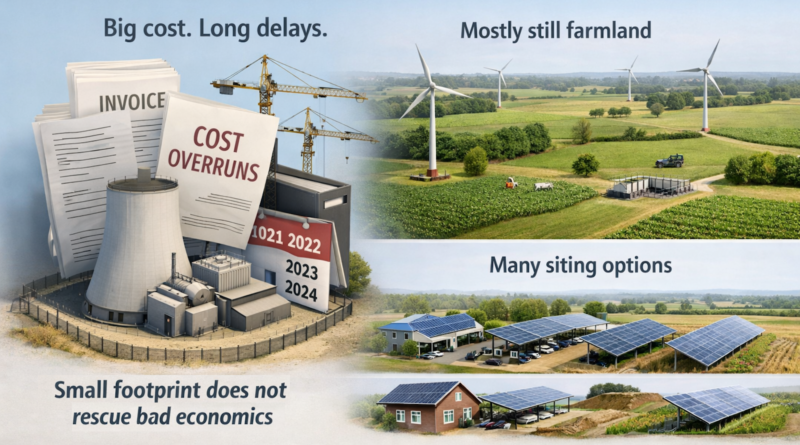
Alright, GoEVDaily readers, let’s talk power. Specifically, where it comes from. You’ve probably seen the meme circulating again – a tiny nuclear plant footprint compared to vast wind farms or solar arrays. It’s often presented as a mic-drop moment, an ‘aha!’ that supposedly settles the debate about the best energy source. But as your friendly neighborhood EV expert, I’m here to tell you it’s a gross oversimplification, and frankly, a bit misleading.
This ‘nuclear uses less land’ argument is a classic cherry-pick, designed to make a complex issue seem black and white. Yes, a nuclear power plant itself occupies a relatively small, fenced-off site. But that’s just one piece of the puzzle. When we talk about land use for energy, we need to consider the entire lifecycle, not just the visible generation point.
Think about it: where does the uranium come from? Mining operations for nuclear fuel are incredibly land-intensive, often involving significant environmental disruption. Then there’s the land required for processing, enrichment, and crucially, for storing nuclear waste – which needs to be safely isolated for tens of thousands of years. That’s a long-term land commitment that dwarfs the visible footprint of a reactor.
Now, let’s look at renewables. Wind turbines are indeed spread out, but much of the land between them can still be used for agriculture, grazing, or other purposes. It’s not ‘consumed’ in the same way. Similarly, while solar farms cover ground, many new installations are on brownfields, industrial rooftops, or even floating on water. And residential solar? It uses land you already own!
More importantly, the land use for renewables is often a one-time thing for installation, with minimal ongoing impact. There’s no equivalent to the perpetual land commitment required for nuclear waste storage. When a wind farm or solar array reaches the end of its life, the land can largely revert to its original state or be repurposed relatively easily.
Why does this matter for us, the EV enthusiasts? Because the source of our electricity is paramount. Charging your electric vehicle with power from a truly sustainable, low-impact grid is part of the promise of going electric. Misinformation about energy sources distracts from the real work of building a robust, clean grid powered by genuine renewables.
We need to advocate for energy policies that consider the full environmental lifecycle, not just what fits neatly into a meme. Renewable energy sources like wind and solar, when considered holistically, offer a far more sustainable and less land-intensive path forward than nuclear, especially when factoring in the long-term burden of waste.
Bottom Line: Don’t fall for the simplistic land use comparisons. When you account for mining, processing, and the eternal challenge of waste storage, nuclear power’s true land footprint is far from ‘small.’ Renewables, with their dual-use potential and finite impact, are still the clear winner for a sustainable EV future.
This article is based on reporting from CleanTechnica. Analysis and commentary are original to GoEVDaily.