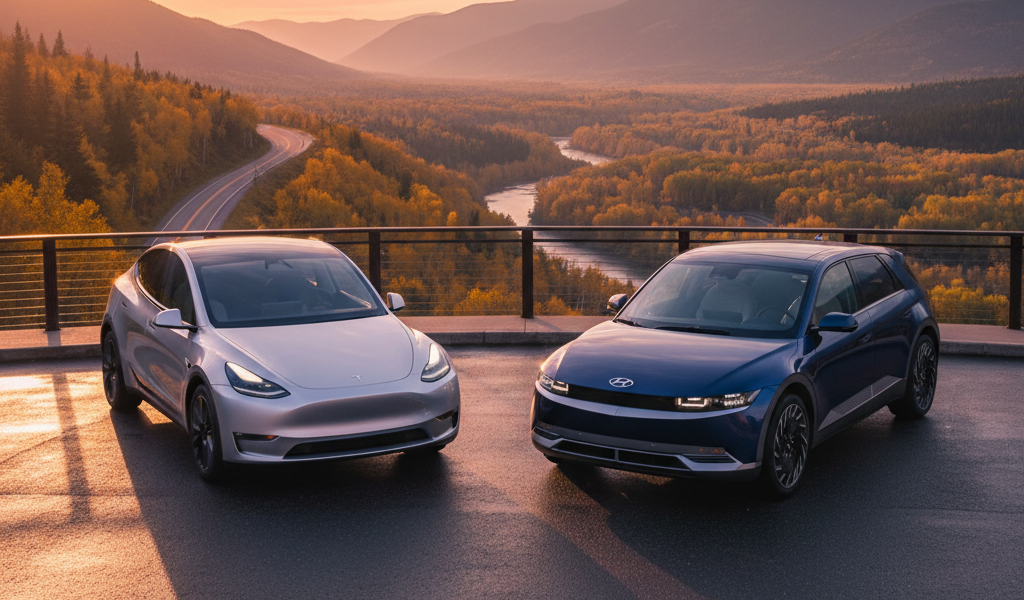
EV6 vs. ID.4: The Midsize EV Battle That Actually Matters for Your Wallet
Okay, folks, let’s get real. You’re probably here because you’re eyeing a midsize EV that won’t break the bank, isn’t some vaporware concept, and actually fits your life. You want something that handles the daily commute, the grocery runs, and maybe even that annual road trip to Grandma’s house without giving you range anxiety. And honestly, for a lot of American families, the choices often boil down to two serious contenders: the Kia EV6 and the Volkswagen ID.4.
I’ve driven both, lived with both (at least for a week at a time), and wrestled with their charging quirks and infotainment systems. My own garage has seen a few EVs come and go, and I know what matters when you’re shelling out your hard-earned cash. So, let’s peel back the layers and see which of these two deserves a spot in your driveway.
Price: Where Your EV Journey Begins (or Ends)
Let’s talk dollars and cents, because for most of us, that’s the ultimate gatekeeper. The 2024 Kia EV6 kicks off with the Light RWD trim at around $42,600 before destination. If you want AWD and more range, you’re looking at the GT-Line e-AWD, which can easily hit $57,600 or more. Kia has a tendency to push you up the trim ladder for features.
The 2024 Volkswagen ID.4 starts a bit lower with the Standard RWD at about $39,735. The AWD Pro S Plus, fully loaded, will run you closer to $55,245. Volkswagen also offers a couple of battery sizes, which can complicate the pricing comparison a bit, but generally, the ID.4 tends to be a smidge more accessible at the entry level.
Winner (Price): Volkswagen ID.4. While both offer a similar top-end price, the ID.4’s lower entry point makes it more attractive for budget-conscious buyers. Keep an eye out for incentives and lease deals, though; those can swing things dramatically.
Range: How Far Can You Really Go?
EPA estimates are one thing, but real-world range, especially when it’s 20 degrees outside and you’re running the heater, is another. The Kia EV6, with its larger 77.4 kWh battery pack, is rated for up to 310 miles in the Long Range RWD trim. The AWD versions drop to around 282 miles. In my experience, even with spirited driving, I consistently got within 10-15% of the EPA range, which is pretty darn good.
The Volkswagen ID.4 offers two battery sizes: a 62 kWh pack (Standard/Pro) and an 82 kWh pack (Pro/Pro S). The 82 kWh RWD Pro S gets an EPA estimated 291 miles, while the AWD versions hover around 263 miles. That 62 kWh pack, by the way, is only rated for 206 miles, which is fine for city driving but a non-starter for my family road trips.
Winner (Range): Kia EV6. That 310-mile RWD model is a champ, and even the AWD versions beat out the ID.4’s best. The EV6 simply offers more usable range across its lineup, especially if you’re avoiding that smaller VW battery.
Charging: Speed Matters on the Open Road
This is where the rubber meets the road, literally. The Kia EV6 is built on an 800V architecture, meaning it can charge incredibly fast if you find a capable DC fast charger. We’re talking 10% to 80% in as little as 18 minutes under ideal conditions, thanks to peak charging rates over 230 kW. This is a game-changer on a road trip. My family once stopped at an Electrify America station, grabbed some snacks, and by the time we were done, the EV6 was ready to roll again.
The Volkswagen ID.4 uses a 400V architecture, which is more common. Its peak DC fast charging rate is around 175 kW for the 82 kWh battery. This translates to a 10% to 80% charge in about 30 minutes. While not slow by any stretch, it’s noticeably longer than the EV6, especially when you’re trying to minimize downtime on a long journey.
Both offer competitive Level 2 (home) charging, typically going from empty to full overnight. But for public DC fast charging, the EV6 is in a different league.
Winner (Charging): Kia EV6. That 800V system is just superior for rapid DC fast charging, which is crucial for real-world usability beyond daily commutes.
Interior: Comfort, Tech, and Family Friendliness
Step inside, and you immediately notice differences. The Kia EV6 has a more futuristic, driver-focused cockpit. The dual 12.3-inch curved displays look slick, and the haptic buttons for climate/media are neat, if sometimes a bit fiddly to use without looking. The floating center console adds to the open feel, and rear legroom is surprisingly generous, a big plus for my growing kids.
The Volkswagen ID.4 goes for a more minimalist, almost minimalist-to-a-fault approach. The 12-inch infotainment screen (on higher trims) is central, but VW’s software has been a source of frustration for many, myself included. It can be laggy, and the touch sliders for volume and temperature are truly terrible at night. Rear seat space is good, and the panoramic glass roof (on Pro S) adds airiness. The overall feel is a bit more conventional SUV.
One thing I appreciate in the EV6 is the physical buttons for frequently used functions, even if some are haptic. The ID.4’s reliance on the screen for almost everything can be distracting. Cargo space is pretty similar, with the EV6 offering 24.4 cubic feet behind the rear seats and the ID.4 slightly less at 30.3 cubic feet (but this is sometimes measured differently due to sloped roofs).
Winner (Interior): Kia EV6. While the ID.4 is spacious, the EV6’s more modern design, superior infotainment interface, and better material quality (especially on higher trims) win out. The ID.4’s UI is still a weak point.
Driving Experience: Fun Factor vs. Smooth Sailing
How do they feel behind the wheel? The Kia EV6, especially in GT-Line or GT guise, feels much sportier. It has a lower center of gravity, sharp steering, and a firm but compliant ride. It feels nimble and engaging, almost like a hot hatch. The instant torque is addictive, and it’s genuinely fun to drive on twisty roads. Even the base RWD models feel responsive.
The Volkswagen ID.4, on the other hand, prioritizes comfort and a serene ride. It feels more like a traditional European SUV. The steering is light, the suspension soaks up bumps effectively, and it’s very quiet inside. It’s not as exciting as the EV6, but it’s a perfectly pleasant daily driver, especially for those who value comfort over canyon carving. Think of it as a smooth, competent cruiser.
Both are quiet, as expected from EVs, and offer good visibility. But their characters are distinctly different.
Winner (Driving Experience): Kia EV6. For me, driving an EV should be engaging, and the EV6 delivers more excitement and a more dynamic feel. If you prefer pure comfort, the ID.4 might appeal more, but the EV6 is simply more fun.
The Bottom Line: Which Midsize EV Wins?
After living with both, pushing their limits, and navigating the sometimes-frustrating public charging landscape, my recommendation is clear. While the Volkswagen ID.4 offers a compelling entry price and a comfortable, traditional SUV feel, it ultimately falls short in key areas that matter for long-term EV ownership: charging speed, real-world range at the lower end, and infotainment usability.
The Kia EV6, with its stunning design, blisteringly fast charging, superior range, and a more engaging driving experience, is the better all-around package. It might cost a little more to get into a well-equipped model, but that investment pays dividends in daily enjoyment and reduced road trip stress. For an American family looking for a midsize EV that genuinely excites and performs, the EV6 is the clear winner.
It’s not just a good EV; it’s a great car, period. And that, my friends, is what truly matters.