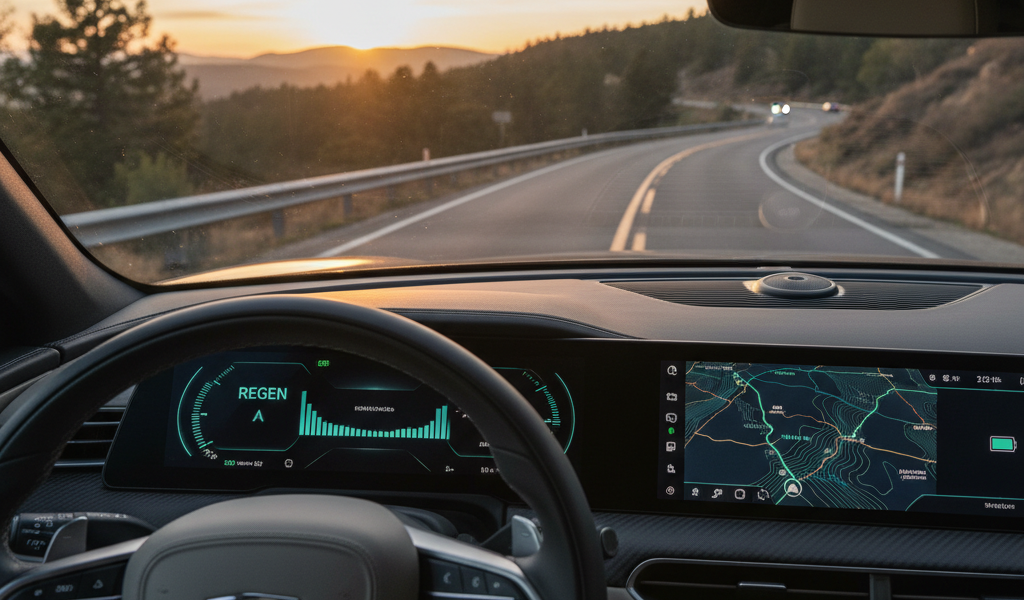
Alright, let’s talk about something that blew my mind when I first started driving EVs: the magic of regenerative braking. For years, I just assumed braking meant throwing energy away – friction, heat, dust from your pads. That’s how it worked in my old gas guzzlers, right? You hit the brakes, the pads squeeze the rotors, and all that kinetic energy, all that momentum you built up, just dissipates into the atmosphere as heat. Gone. Poof.
But then I got my first EV, a Tesla Model 3 Long Range, and it felt… different. I found myself barely touching the brake pedal. Coming off the highway, coasting down a hill, even just slowing for a red light – the car would just… slow down, smoothly, without me doing much. And the range counter? It wasn’t dropping as fast as I expected. That, my friends, is the power of regenerative braking, and it’s one of the unsung heroes of electric vehicle efficiency.
What Exactly Is Regenerative Braking? (No Engineering Degree Required)
Think about a bicycle generator. You pedal, a small generator spins, and it powers your lights. Now, imagine if you could flip that around. If you were going downhill, and the wheels were spinning the generator, what if that generator could actually recharge a battery? That’s the simplest way to understand regenerative braking.
In your EV, the electric motor isn’t just a motor; it’s also a generator. When you’re accelerating, electricity flows from the battery to the motor, spinning the wheels. When you lift your foot off the accelerator (or gently press the brake pedal, depending on your car’s setup), the car’s computer senses that you want to slow down.
Instead of just letting friction brakes do all the work, it reverses the flow. The wheels, still spinning, now start to turn the motor. But instead of the motor using electricity to spin, it’s now being spun by the wheels, acting like a generator. This generates electricity, which is then sent back to recharge your high-voltage battery. It’s literally converting your car’s kinetic energy (the energy of motion) back into electrical energy.
The ‘One-Pedal Driving’ Revolution
This is where regenerative braking really shines and changes the driving experience. Many EVs, like my Tesla, the Kia EV6, or the Hyundai Ioniq 5, offer what’s called ‘one-pedal driving.’ You set a high level of regeneration, and when you lift your foot off the accelerator, the car slows down quite aggressively, often enough to bring you to a complete stop without touching the brake pedal at all.
My wife, bless her heart, hated it at first. She’s used to coasting in her Honda CR-V. But after a week of driving the Tesla, she admitted, “Okay, this is actually really intuitive in traffic.” And she’s right. In stop-and-go city driving, it’s a game-changer. You’re constantly feeding energy back into the battery, making those short trips surprisingly efficient.
Why This Matters for Your Next EV Purchase: More Miles, Less Wear, More Fun
1. Significantly Extended Range
This is the big one. Every time you slow down, you’re not just wasting energy; you’re harvesting it. This means you get more miles out of a single charge. How much more? It varies wildly depending on your driving style and terrain. In heavy city traffic, where you’re constantly accelerating and decelerating, you could see a 10-20% boost in effective range compared to highway driving where you’re maintaining a steady speed.
I’ve personally seen my estimated range on my Model 3 jump by 10-15 miles on my regular 40-mile commute when traffic is particularly bad, simply because I’m regenerating so much. On a long road trip from California to Arizona, descending mountain passes, I’ve even seen my battery percentage go up a point or two! Try that in a gas car.
2. Reduced Brake Wear & Maintenance Costs
Remember those friction brakes? They’re still there, and they’re crucial for emergency stops or when you need maximum stopping power. But with strong regenerative braking, you’re using them far less frequently. This means your brake pads and rotors last significantly longer.
In my Tesla, after 60,000 miles, my original brake pads are still looking fantastic. Most gas cars would have needed new pads, if not rotors, by now. That’s a real-world saving, folks – easily $300-$500 every 30,000-50,000 miles. It’s a small but tangible perk that adds up over the lifetime of the vehicle.
3. Smoother, More Comfortable Driving
Once you get used to it, regenerative braking provides incredibly smooth deceleration. There’s no jerky downshifting or abrupt braking. It’s a seamless, controlled slowdown that makes for a more relaxed driving experience, especially in traffic. It also gives you more precise control over your speed without having to constantly move your foot between pedals.
4. Different Levels for Different Folks
Not everyone loves aggressive one-pedal driving, and that’s okay. Most EVs allow you to adjust the level of regenerative braking. Want it mild, barely noticeable? You can do that. Want it strong enough to almost never touch the brake pedal? That’s an option too. For example, the Ford Mustang Mach-E offers different drive modes that change the regen aggressiveness, letting you dial in what feels best for you.
The Myth of ‘Free’ Energy (and Cold Weather Challenges)
Now, let’s be real. It’s not truly ‘free’ energy in the sense of creating something from nothing. It’s about recovering energy that would otherwise be wasted. And there are some caveats.
One common complaint from new EV owners, especially in colder climates like where my cousin lives in Colorado, is that regenerative braking can feel weaker in cold weather. This is because lithium-ion batteries are less efficient at accepting a charge when they’re cold. Your car’s battery management system will limit the amount of regeneration to protect the battery.
My Model 3, for instance, will show a dashed line on the power meter when it’s cold, indicating reduced regen. It usually comes back to full strength once the battery warms up from driving. So, if you live somewhere that sees real winters, just know that your regen might not be as punchy until you’ve driven for a bit.
Bottom Line: Regen is a Must-Have EV Feature
Regenerative braking isn’t just a fancy technical term; it’s a fundamental part of what makes electric vehicles so efficient and enjoyable to drive. It extends your range, saves you money on maintenance, and offers a unique, smooth driving experience. When you’re test-driving your next EV, pay close attention to how the regenerative braking feels. Ask the salesperson to demonstrate one-pedal driving if it’s available. It’s not just a gimmick; it’s a core technology that puts miles back in your battery and money back in your wallet. Don’t buy an EV without strong regen capabilities.